
Deep Networking: The Network That Thinks
For a decade, the networking industry optimized for the wrong thing. Networks were treated as a commodity. That model was good enough for the era it was built for — it is not good enough for AI.
The organizations that win the AI era will be the low-cost producers of intelligence, and token efficiency is how that gets measured. While networking is just 10–15% of an AI cluster’s cost, any inefficiency has an outsized impact on accelerator utilization, training throughput, and inference latency. The network is where token efficiency is won or lost. Deep Networking is our answer.
What Deep Networking Is
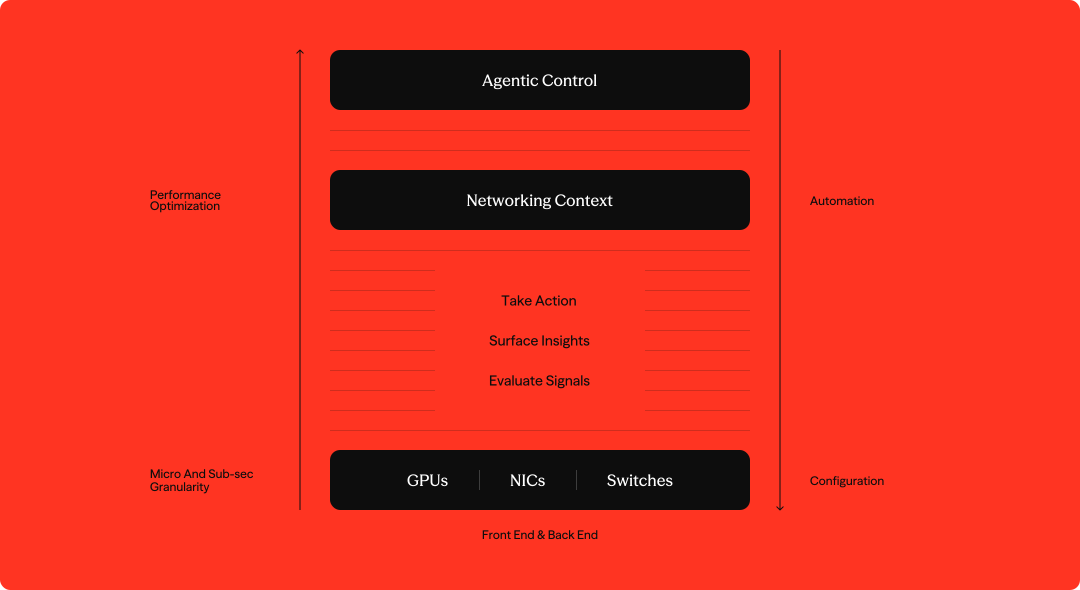
Deep Networking is not a feature bolted onto an existing stack, and it is not a large language model slapped on top of legacy tooling. Specializing AI for a domain that fuses hardware and software requires the approach self-driving systems took: purpose-built hardware as the foundation, with specialized intelligence built on top.
AI-Class Hardware
Leading 800GbE and 1.6Tbps switches on Broadcom silicon, running AriaOS, a highly reliable and hardened operating system developed from an open-source SONiC foundation and the reliability production demands.
Fine-Grained Telemetry
Telemetry at 100 to 10,000× the resolution of traditional tools — microsecond buffer states, optical signal degradation, host-level events — processed in real time, entirely within the cluster.
End-to-End
Spans the full stack: ASIC to host, switch to accelerator, across backend training and frontend inference. Horizontally open for any xPU — NVIDIA, AMD, and the accelerators still being designed.
Agentic Operations
Intelligent agents live at every layer, from microsecond reactions at the ASIC to issue resolution in the cloud — moving from detection to diagnosis to resolution without waiting for someone to notice.
What Deep Networking Delivers
If you run a network, everything changes the moment you get real visibility.
01.
Real visibility
Most legacy tools sample every few seconds — the difference between a strobe light and a continuous beam. Deep Networking operates at microsecond resolution, so brief spikes, packet loss, and signal degradation surface the moment they occur.
02.
One timeline
When something breaks, NIC, network, xPU, and job metrics live in four different tools. Deep Networking puts every layer on the same timeline — so you stop chasing the wrong suspect.
03.
Maximum leverage
Token efficiency is the defining metric of the AI factory era. A 10% gain in tokens per second is a 10% gain in revenue. The network is where that gain starts.
When these three outcomes compound, the network stops operating as a constraint and starts operating as a multiplier. That holds whether the workload is training or inference, and whether the underlying architecture is GPUs, TPUs, or custom silicon.
Why It Matters For Inference
Inference performance comes down to time to first token, inter-token latency, and tail percentiles — and the network directly affects each. When you fan out a request across a cluster, a single stalled path delays the response. Optimizing the fabric is one of the most direct ways to improve token efficiency and cost per token. An expensive cluster that under-delivers is still an expensive cluster. The network is where that changes.
Getting Started
Deep Networking is live, shipping, and serving customers in production today. We deploy Forward Deployed Engineers who become an extension of your networking team — when you need support, the people on your call are the people who built the system.

